Encourages balanced discussion about the Gig-Economy
4 júní, 2025 - 14:16

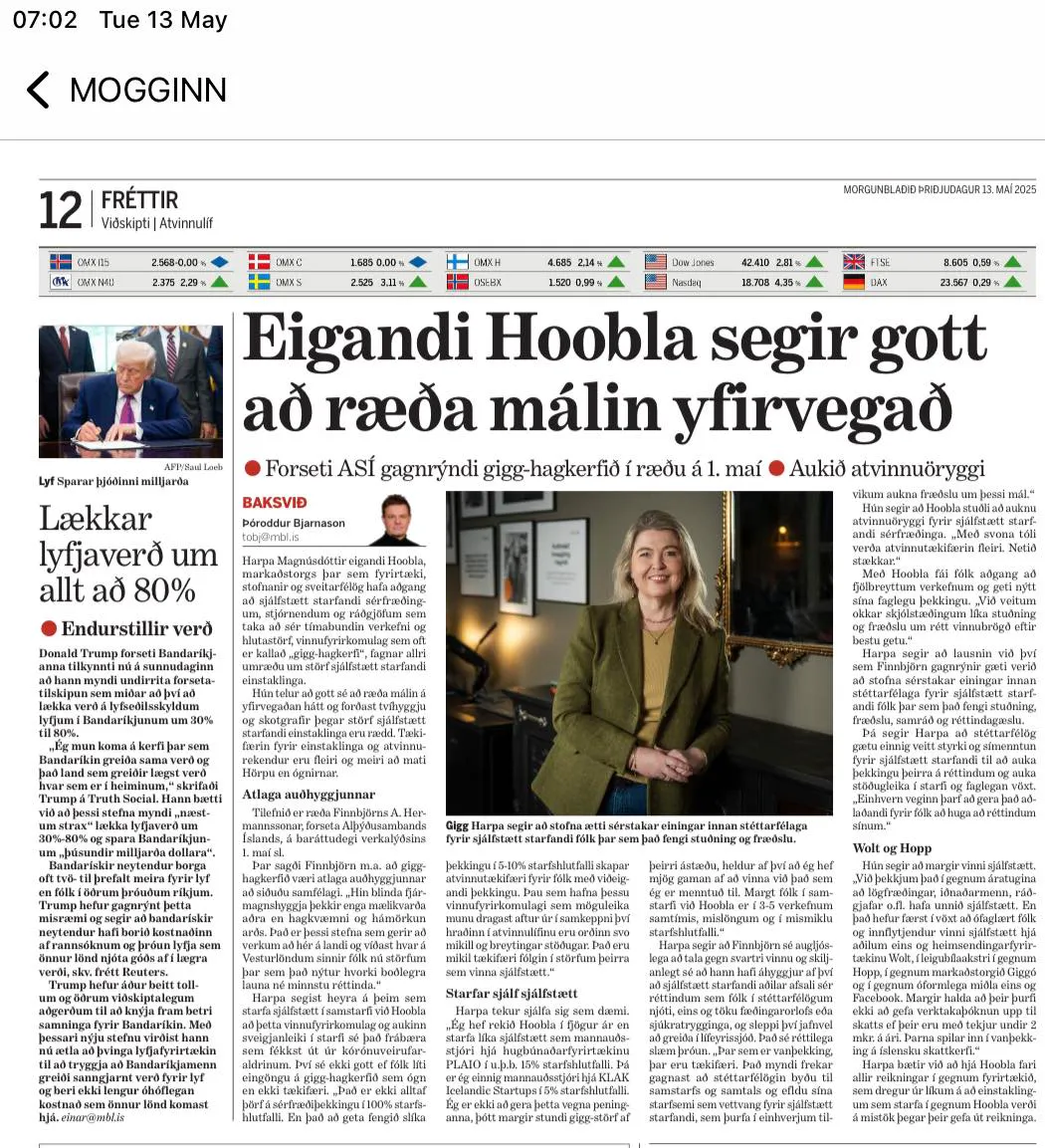
Harpa Magnúsdóttir, founder and owner of Hoobla, welcomes the willingness within the business community to discuss the Icelandic Gig-Economy and encourages that the conversation be balanced and constructive.
Here beneath is the interview with Harpa that was published in Morgunblaðið and was conducted following the president of the Icelandic Confederation of Labour’s (ASÍ) critical remarks in a speech on May 1st.:
An Assault by Capitalism
The occasion is a speech by Finnbjörn A. Hermannsson, president of the Icelandic Confederation of Labour (ASÍ), on International Workers’ Day, May 1st.
In his speech, Finnbjörn stated, among other things, that the gig economy is an assault by capitalism on civilised society. “Blind financial capitalism recognises no other values than efficiency and profit maximization. It’s this ideology that results in people, both here in Iceland and across the Western world, working in jobs where they receive neither fair pay nor basic rights.”
A new perspective on flexibility
Harpa says she hears from freelancers working with Hoobla that this way of working—and the increased flexibility it provides—is one of the best things to come out of the COVID pandemic. She stresses that it’s unfortunate if people view the gig economy only as a threat and not as an opportunity.
“There isn’t always a need for full-time access to expert knowledge. But being able to access it at 5–10% capacity creates job opportunities for people with relevant expertise. Those who reject this model will fall behind in the competition, because the pace of the job market has increased dramatically and change is constant. There are great opportunities in the kind of work that independent professionals are doing.”
She works independently herself
Harpa uses herself as an example. “I’ve been running Hoobla for four years, but I also work independently as an HR director at the software company PLAIO at about 15% capacity. I also serve as HR director at KLAK – Icelandic Startups at 5% capacity. I don’t do this for the money—though many people take on gig work for that reason—but because I truly enjoy working in the field I was trained in. Many people working through Hoobla are engaged in 3–5 projects at the same time, of varying duration and workload.”
Harpa notes that Finnbjörn is clearly warning against undeclared (black market) work, and it’s understandable that he’s concerned about freelancers giving up rights that unionised employees have—such as parental leave or health insurance—and sometimes skipping pension contributions. That, she agrees, is a worrying trend. “Where there’s a lack of knowledge, there’s also opportunity. Rather than criticism, it would be more productive if unions offered collaboration and dialogue, and strengthened their role as a platform for freelancers—many of whom do need more education on these topics.”
Hoobla increases security
She explains that Hoobla promotes job security for independent professionals. “With tools like this, job opportunities increase. The network expands.”
Through Hoobla, people gain access to diverse projects and can apply their professional skills. “We also provide our clients with guidance and training on best practices in the workplace.”
Harpa says the solution to the concerns Finnbjörn raises could be the creation of dedicated freelancer branches within trade unions, where they could receive support, training, consultation, and representation for their rights.
She also suggests that unions could offer grants and continuing education for freelancers to strengthen their awareness of their rights, increase job stability, and support their professional development. “We somehow need to make it more attractive for people to think about their rights.”
Wolt and Hopp
She points out that many people work independently. “We’ve known for decades that lawyers, tradespeople, consultants and others often work independently. But it’s increasingly common now that unskilled workers and immigrants work independently—for example through delivery services like Wolt, ride-hailing with Hopp, platforms like Giggó, and informal channels like Facebook. Many assume they don’t need to report contractor income to tax authorities if they earn less than 2 million ISK per year. This is largely due to lack of knowledge about Iceland’s tax system.”
Harpa adds that at Hoobla, all invoices go through the company, reducing the risk of freelancers making mistakes when issuing invoices.
Harpa MagnusdottirFounder & CEO